|


         
 

 
|
|
Anuradhapura wurde im 4. Jh.
v. Chr. Gegründet und war Sri Lankas erste Hauptstadt.
අනුරාධපුර
Anuradhapura
|
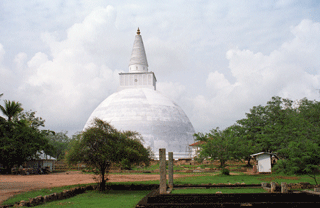
Abhayagiri
Dagoba
|
Hier
geht's weiter zu den Bilder Gallerin:
Abhayagiri
Dagoba
(03. Bilder)
|
|
The Abhayagiri Dagaba is situated in
Anuradhapura, Sri Lanka. It is one of the most extensive ruins in the
world and one of the most sacred Buddhist pilgrimage cities.
Historically it was a great monastic centre as well as a royal capital,
with magnificent monasteries rising to many stories, roofed with gilt
bronze or tiles of burnt clay glazed in brilliant colors. To the north
of the city, encircled by great walls and containing elaborate bathing
ponds, carved balustrades and moonstones, stood "Abhayagiri", one of
seventeen such religious units in Anuradhapura and the largest of its
five major viharas. Surrounding the humped dagaba, Abhayagiri Vihara
was a seat of the Northern Monastery, or Uttara Vihara.
|
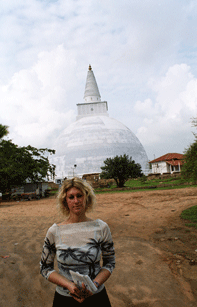
Sandra vor der
Abhayagiri Dagoba
|
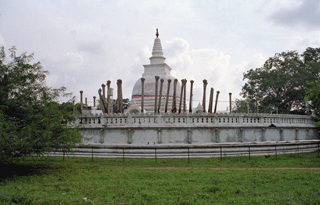
Thuparamaya
Dagoba
|
Hier
geht's weiter zu den Bilder Gallerin:
(07. Bilder)
|
|
Thuparamaya is a dagaba in Anuradhapura, Sri
Lanka.
Thera Mahinda himself introduced Theravada Buddhism and
also chetiya worship to Sri Lanka. At his request King Devanampiyatissa
built Thuparamaya in which was enshrined the collarbone of the Buddha
and is considered as the first dagaba built in Sri Lanka, after the
introduction of Buddhism. This is considered the earliest monument of
chronicled Sri Lanka. The name Thuparamaya comes from "stupa" and
"aramaya" which is a residential complex for monks.
|
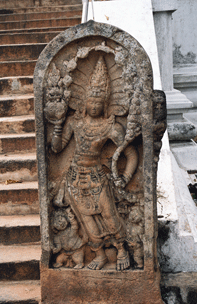
Thuparamaya
Dagoba
|
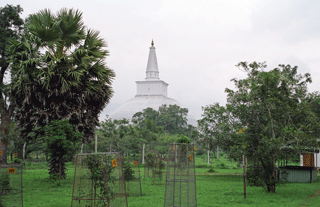
Ruwanwelisaya Dagoba
|
Hier
geht's weiter zu den Bilder Gallerin:
Ruwanwelisaya
Dagoba
(03. Bilder)
|
|
The Ruwanwelisaya is a stupa in Sri Lanka,
considered a marvel for its architectural qualities and sacred to many
Buddhists all over the world. It was built by King Dutugemunu, who
became lord of all Sri Lanka after a war in which the Chola King Elara,
were defeated. It is also known as Mahathupa, Swarnamali
Chaitya and Rathnamali Dagaba.
The stupa is also one of the Solosmasthana (the
16 places of veneration) and the Atamasthana (the 8 places of
veneration in the ancient sacred city of Anuradhapura). The stupa is
one of the world's tallest monuments, standing at 300 ft (92 m) and
with a circumference of 950 ft (292 m).
|
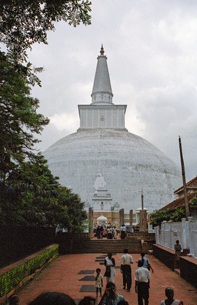
Ruwanwelisaya Dagoba
|
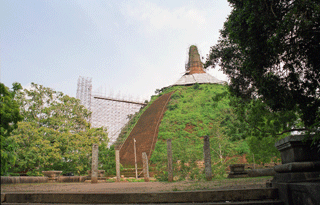
Jetavanaramaya
Dagoba
|
Hier
geht's weiter zu den Bilder Gallerin:
Jetavanaramaya
Dagoba
(07. Bilder)
|
|
The Jetavanaramaya is a stupa, located in the
ruins of Jetavana Monastery in the sacred city of Anuradhapura, Sri
Lanka.
King Mahasen (273-301 AD) has the honour of being the
creator of the largest stupa in Sri Lanka. A part of a sash or belt
tied by the Buddha is believed to be the relic that is enshrined here.
|
Jetavanaramaya
Dagoba
|

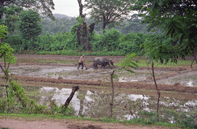
Reisfelder...
|
Hier
geht's weiter zu den Bilder Gallerin:
Landschaft
um Anuradhapura
(08. Bilder)
|
|
Anuradhapura (Sinhala: අනුරාධපුර, Tamil:
அனுராதபுரம்) ist die Hauptstadt der Nördlichen Zentralprovinz von Sri
Lanka. Sie war über tausend Jahre lang Zentrum verschiedener
singhalesischer Königsdynastien.
|
Reisfelder...
|
Mahasena
Palast
|
Hier
geht's weiter zu den Bilder Gallerin:
Mahasena
Palast
(11. Bilder)
|
|
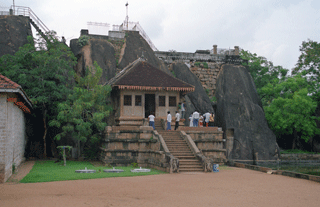
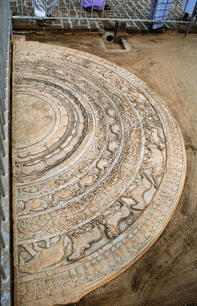
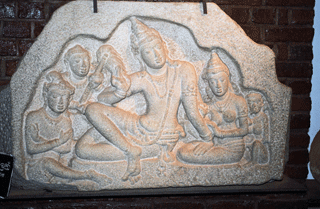
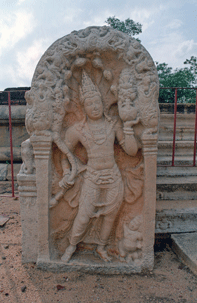
Von einem Mahasen (Mahasena) Palast stehen nur noch die
steinernen Teile. Die Säulen trugen ein hölzernes Dach. Zu Füßen
einiger Treppen befinden sich die berühmten, mit verschiedenen
Tiermotiven verzierten Mondsteine. Hier soll sich auch einige Zeit lang
der Zahn Buddhas befunden haben, der heute in Kandy aufbewahrt wird.*
|
Mahasena Palast
|
Mahasena
Palast
|
|
| |
Mahasena Palast
|
Samaddi
Buddha
|
Samadhi Buddha
|
|
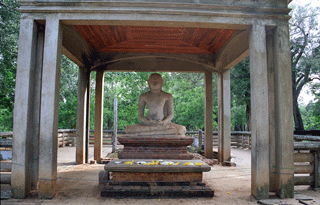
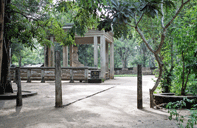
Samadhi statue is a statue situated at
Mahamevuna Park in Anuradhapura, Sri Lanka. It is said that this is one
of the best pieces of sculpture. The statue is 8 feet in height and
made of granite and the Dhyana mudra is symbolished - The
posture of meditation in which Buddha sits in the cross - legged
position with upturned palms, placed one over the other on the lap.
|
Samadhi Buddha
|
Sandra beim Ratna
Prasada
|
Ratna Prasada
|
Letzte Aktualisierung & Neugestaltung: 19.08.2014
|
Copyright:
Sämtliche Inhalte wie Fotos,
Grafiken, Texte, Design, Musikfiles, usw., auf von Autor erstellten
Seiten sind Urheberrechtlich geschützt. Das Copyright für
veröffentlichte, vom Autor selbst erstellte Objekte bleibt allein beim
Autor der Seiten. Eine Vervielfältigung oder Verwendung solcher
Grafiken, Tondokumente, Videosequenzen und Texte in anderen
elektronischen oder gedruckten Publikationen ist ohne ausdrückliche
Zustimmung des Autors nicht gestattet.
|
|
Alle
diese Texte, wenn nicht anders gekennzeichnet, basieren auf den Artikel: Abhayagiri
Dagaba,
Thuparamaya, The
Ruwanwelisaya, The
Jetavanaramaya, Samadhi statue, Anuradhapura
aus der freien Enzyklopädie Wikipedia
und steht unter der
GNU-Lizenz für freie Dokumentation.
In der Wikipedia ist eine
Liste der Autoren
verfügbar.
|
|
PayPal
Spenden
Wenn dir das Angebot von den
Asiatischen Urlaubsgalerien gefallen hat, kannst du gerne mit einer
beliebig großen Spende dazu beitragen, dass es dieses Angebot auch in
Zukunft noch gibt. Jeder Cent ist dabei willkommen.
Klicke zum Spenden bitte auf den
PayPal Button unten um die Spende über PayPal abzuwickeln.
|



